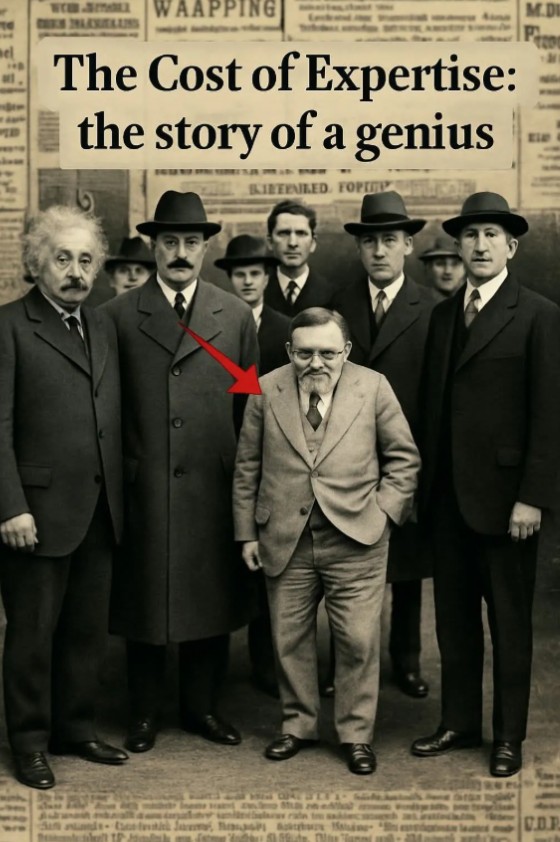
You’ve probably heard the old tale about the engineer who charged $10,000 to fix a machine:
$1 for turning the right screw and $9,999 for knowing which screw to turn.
Well, it’s not just a legend — the engineer was real. His name was Charles Proteus Steinmetz (1865–1923), a brilliant mind in electrical engineering.
One day, at Henry Ford’s River Rouge plant, a massive generator broke down. None of Ford’s own engineers could figure out the problem. So, Ford called in Steinmetz. When he arrived, Steinmetz asked for only three things: a notebook, a pencil, and a cot.
He spent two days and nights listening to the machine, jotting down calculations. Finally, Steinmetz requested a ladder, a tape measure, and a piece of chalk. He climbed up the generator, took a few measurements, and marked a spot with an X.
Turning to Ford’s engineers, he said:
“Remove this panel, unwind the coil exactly here, and take out 16 turns of wire.”
They did — and the generator roared back to life.
The cost was $10,000 (roughly 150,000+ today)
When Ford requested an itemized bill for the “simple” fix, Steinmetz listed:
Marking the spot with chalk: $1
Knowing where to put it: $9,999
Highlighting that expertise, not just labor, holds the highest value. Ford paid the bill without question.
This story was later documented by Jack B. Scott, the son of one of Ford’s employees, in Life magazine in 1965.